- 01535 652338
- mail@watsonsbs.com


Blog

How Much Energy Can a Well-Optimised BMS Actually Save?
WBS
General
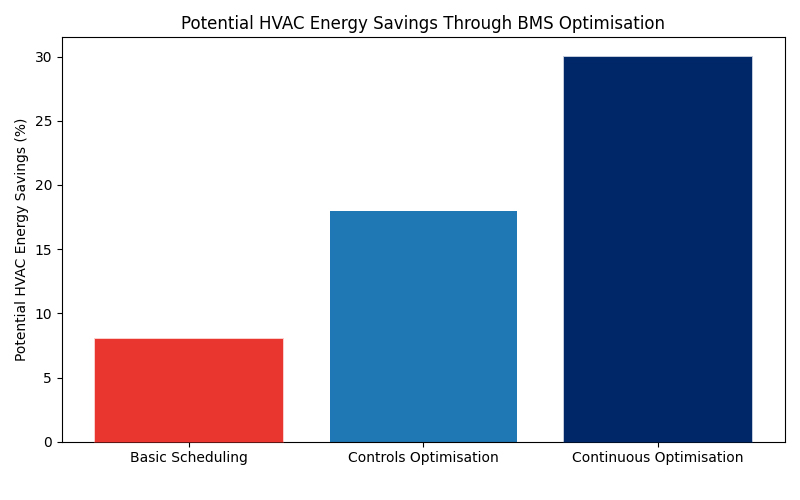
A well-optimised Building Management System (BMS) can significantly reduce energy consumption in commercial buildings by improving how HVAC and other building services operate. In many cases, organisations achieve HVAC energy savings of 10-30% through better scheduling, smarter controls, fault detection, and ongoing optimisation.
Over time, schedules become outdated, sensors drift out of calibration, control strategies are overridden, and buildings evolve beyond their original commissioning settings. The system continues to run, but not necessarily efficiently. Because HVAC systems commonly account for around 40% or more of total building energy consumption, even relatively small inefficiencies can have a major financial impact.
Improving BMS performance can reduce operating costs, improve occupant comfort, and support sustainability goals without requiring major equipment replacement.
Where Energy Waste Typically Occurs
Most building energy waste develops gradually through inefficient operation rather than major equipment failure. Common causes of excessive energy use include:
- HVAC systems and lighting running outside occupancy hours
- simultaneous heating and cooling
- poor temperature setpoints
- outdated schedules
- fans and pumps operating at constant speed
- ventilation systems supplying more air than necessary
These issues are often difficult to spot because the building may still appear to function normally from an occupant's perspective. However, behind the scenes, unnecessary runtime and poor control logic can significantly increase energy consumption. This is why simply having a BMS installed does not guarantee efficiency. Without ongoing review and optimisation, a system can end up automating inefficiency rather than preventing it.
What Makes a BMS Well-Optimised?
A well-optimised BMS continuously adjusts building operation based on real conditions rather than relying on static assumptions.
Instead of running systems at full output throughout the day, equipment responds dynamically to demand. Ventilation rates can adjust based on occupancy and CO₂ levels, variable speed drives can reduce fan and pump energy at lower loads, and boilers or chillers can sequence more efficiently to avoid unnecessary runtime.
Scheduling is often one of the biggest opportunities for improvement. Many buildings continue operating on legacy schedules that no longer reflect actual occupancy patterns. Aligning system runtime more closely with how spaces are used can produce immediate energy savings with minimal capital investment.
Optimisation also helps identify hidden faults that may otherwise persist unnoticed, such as leaking valves, failed sensors, poorly tuned control loops, or simultaneous heating and cooling. BMS reviews regularly uncover these issues in buildings that otherwise appear to be operating normally.
The Financial and Operational Benefits
Because HVAC systems represent such a large share of building energy use, even modest efficiency improvements can translate into substantial cost reductions. A building spending £100,000 annually on HVAC energy could save £15,000 per year through a 15% reduction in consumption. Larger estates and energy-intensive facilities can achieve considerably higher savings.
Importantly, many BMS optimisation projects focus on refining controls, recommissioning systems, and improving operational visibility rather than replacing major plant equipment. This often makes optimisation significantly more cost-effective than large-scale retrofit projects.
Although reducing energy consumption is often the primary goal, the benefits of BMS optimisation also extend well beyond utility savings. Buildings with well-managed controls typically experience:
- more stable indoor temperatures
- improved occupant comfort
- reduced equipment wear
- better fault visibility
- stronger sustainability performance
As buildings become increasingly data-driven, ongoing optimisation is becoming less of a one-off project and more of a continuous operational strategy.
Upgrade vs Replace: A Simple Decision Framework
When reviewing an underperforming Building Management System, one of the most common questions is whether the system should be upgraded or fully replaced. In many cases, a complete replacement is not immediately necessary. A targeted upgrade may be the better option if:
- The core BMS infrastructure is still reliable
- The system supports modern integrations
- Controls can be recommissioned or reprogrammed
- Operational issues are primarily related to strategy, scheduling, or visibility
However, replacement may become more practical when:
- Hardware is obsolete or unsupported
- Spare parts are difficult to source
- The system lacks cybersecurity compliance
- Integration between systems is limited
- The existing platform can no longer support operational requirements.
The right decision usually depends on the balance between lifecycle cost, operational risk, energy performance, and future building requirements. For many organisations, the best starting point is a professional BMS audit.
Our auditing services help identify hidden inefficiencies, assess system performance, and provide clear recommendations on whether optimisation, upgrades, or replacement will deliver the greatest long-term value.
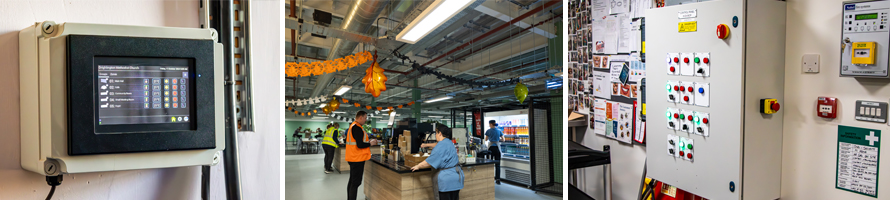
Watsons Building Services delivers tailored BMS solutions across a wide range of buildings and sectors, with systems configured to meet the specific operational requirements of each facility.
Building efficiency is not determined by equipment alone. The way systems are controlled has a major impact on energy performance, operational costs, and occupant experience. A well-optimised BMS helps buildings respond more intelligently to real demand, reducing unnecessary energy use while improving reliability and operational visibility.
Innovation, Expertise, Excellence: The Building Management System Experts
For many organisations, the challenge is identifying where inefficiencies exist and understanding which improvements will deliver the greatest operational impact. At WBS, we support organisations through BMS audits, controls optimisation, upgrades, and ongoing support services designed to improve building performance, reduce operational waste, and help systems operate more efficiently over the long term.
Frequently Asked Questions
BMS optimisation involves improving the way a Building Management System controls and manages building services such as heating, cooling, ventilation, pumps, and lighting. This typically includes refining schedules, adjusting control strategies, improving setpoints, identifying hidden faults, and ensuring systems respond more accurately to real building demand. The goal is to reduce unnecessary energy use while maintaining occupant comfort and operational performance.