- 01535 652338
- mail@watsonsbs.com


Blog
LED Lighting Design: Beyond the Spotlight
WBS
General
Modern lighting systems can actively respond to occupancy levels, make use of natural daylight, reduce maintenance requirements and lower operational costs throughout their lifecycle. When these elements are considered together, lighting becomes not just an energy-saving measure but a strategic asset that supports sustainability, operational efficiency and long-term cost reduction.
For organisations seeking to reduce energy costs and carbon emissions while improving building performance, the greatest opportunities often lie beyond the luminaires themselves.
Why Lighting Remains a Major Energy Opportunity
Despite significant efficiency improvements over the past decade, lighting continues to represent one of the largest controllable energy loads within commercial buildings. This clearly highlights the importance of efficient design and control strategies.
Many buildings still operate lighting systems that run unnecessarily due to poor controls, outdated scheduling or ineffective use of available daylight. This means substantial savings remain available even after an LED upgrade has been completed.
Lighting Controls & Daylight Harvesting
One of the most effective ways to improve lighting efficiency is to ensure that lighting operates only when required.
Lighting controls automatically adjust operation based on occupancy, time schedules or user requirements. In many buildings, lights remain operational in unoccupied meeting rooms, storage areas, circulation spaces and welfare facilities simply because there is no automated control strategy in place.
Common lighting control solutions include:
- Occupancy and vacancy sensors
- Time scheduling
- Zoned lighting control
- Centralised lighting management
- Integration with Building Management Systems (BMS)
Daylight harvesting systems use light sensors to continuously monitor available daylight and automatically adjust artificial lighting levels accordingly. The result is a consistent lighting environment that reduces energy consumption without compromising occupant comfort.
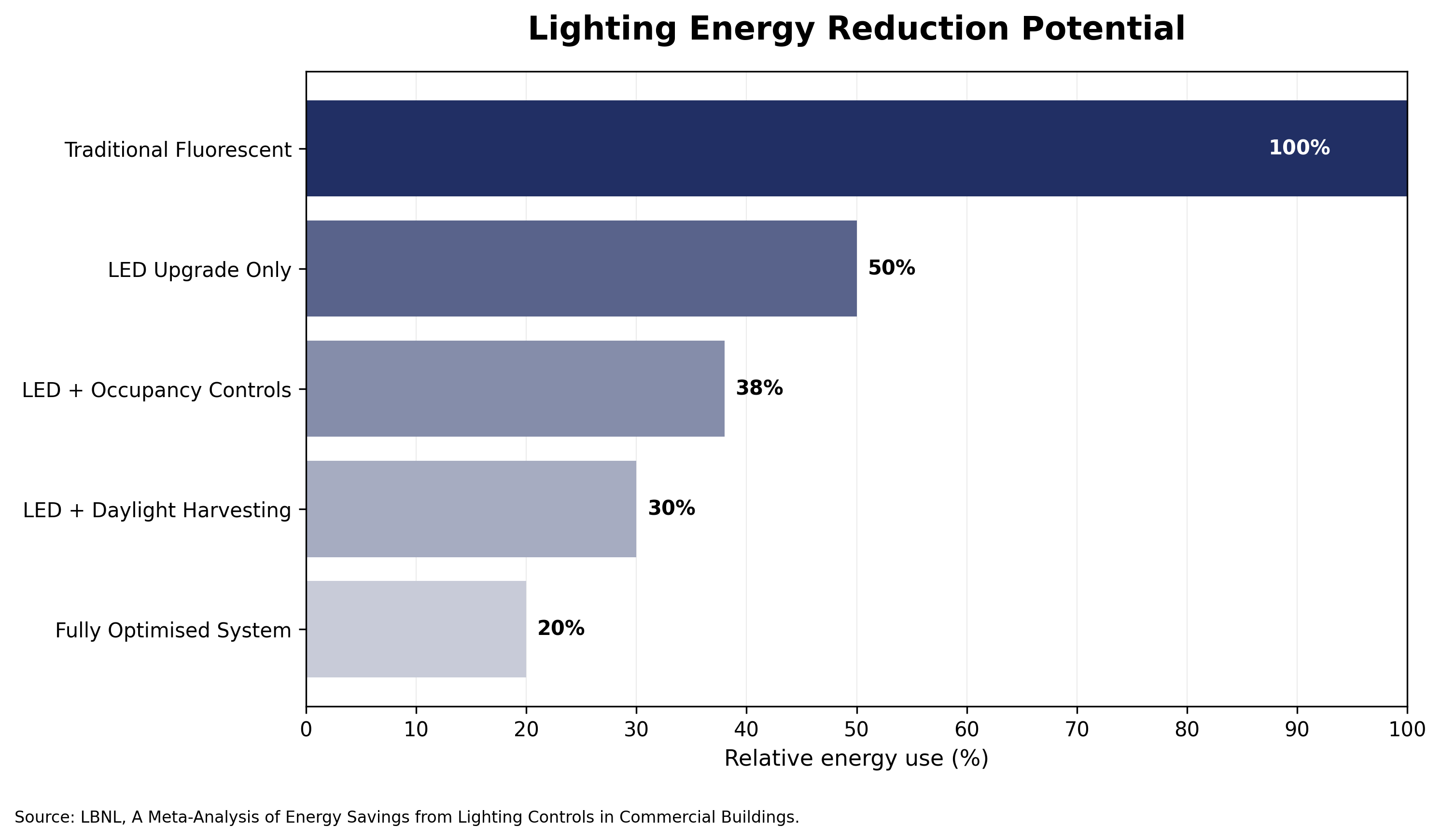
A meta-analysis by Lawrence Berkeley National Laboratory (LBNL), reviewing more than 240 commercial building studies, found that occupancy sensors delivered average lighting energy savings of 24%, while daylight harvesting controls achieved average savings of 28%.
The study also found that combining multiple control strategies typically produces significantly greater reductions than any single measure alone. For warehouses, offices, schools and healthcare environments, occupancy-based control often provides one of the fastest returns on investment available within a lighting project.
Emergency Lighting Can Contribute to Sustainability Too
Emergency lighting is often overlooked during discussions about energy efficiency. Traditional emergency lighting systems frequently rely on dedicated fittings that operate continuously and require extensive manual testing programmes. While essential for safety and compliance, these systems can create unnecessary maintenance burdens and energy consumption.
Modern LED emergency lighting systems provide a more sustainable alternative through:
- Lower energy consumption
- Longer service life
- Reduced battery replacement frequency
- Automated self-testing functions
- Centralised monitoring capabilities
The longer service life of LED technology, identified by the US Department of Energy's Solid-State Lighting Programme, also contributes to reduced maintenance requirements across emergency lighting installations.
For larger facilities, this can translate into meaningful operational savings alongside regulatory compliance benefits.
Looking Beyond Capital Cost: Whole-Life Cost Analysis
The lowest installation cost rarely represents the lowest overall cost. A higher-quality lighting installation incorporating controls, daylight harvesting and intelligent monitoring may cost more initially, but often delivers substantially lower operating costs over its lifespan. British and European Standard BS EN 15459 - Economic Evaluation of Energy Systems in Buildings suggests that sustainable lighting design should be assessed using a whole-life cost approach that considers:
- Initial installation costs
- Energy consumption
- Maintenance requirements
- Replacement cycles
- Compliance testing
- Operational disruption
- End-of-life disposal
For facilities managers responsible for long-term asset performance, whole-life cost analysis provides a more accurate measure of value than purchase price alone.
CASE STUDY SPOTLIGHT
Integration of M+E Services into the Existing Infrastructure of a Grade II Listed Building
The project included a full design and installation of mechanical and electrical solutions, integrating with the site's existing infrastructure. Lighting to the Marsh Lounge included the installation of low-voltage recessed track rails, which fit seamlessly with the building architecture. A Dali system organised the atmospheric lighting into groups designed to give flexible control of the lights by scene setting.
READ THE FULL CASE STUDY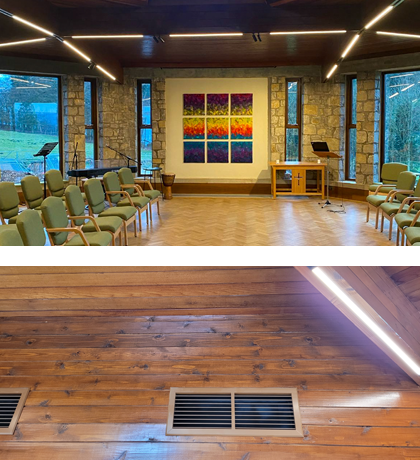
How We Approach Lighting Design
Watsons Building Services provides complete lighting design, installation, controls integration and maintenance solutions across commercial, industrial, healthcare and public-sector environments.
Our approach focuses on more than energy savings alone. We help clients develop lighting systems that support operational efficiency, occupant comfort, sustainability objectives and long-term asset performance through intelligent design and lifecycle planning.
Whether you're considering an LED upgrade or a complete lighting redesign, our team can help identify opportunities to improve performance while reducing whole-life costs.
Innovation, Expertise, Excellence: Smarter lighting, lower energy use.
Connect with Watsons Building Services to discuss your lighting requirements. Our experienced team designs and installs energy-efficient lighting systems tailored to your premises, helping to improve visibility, occupant comfort and long-term operational efficiency.