- 01535 652338
- mail@watsonsbs.com


Blog
Specifying a Commercial Heat Pump: Five Key Questions
WBS
Guides
A commercial heat pump cannot simply be sized against the existing boiler output. Successful retrofits depend on how the building, heating system, electrical infrastructure and controls work together.
Our commercial heat-pump solutions consider those five critical questions before equipment is specified.
01
What is the building’s actual heat demand?
Commercial boilers are often oversized, so their rated output is rarely a reliable guide. Selecting a heat pump by matching the combined boiler rating can produce an unnecessarily large and expensive system.
A heat pump must be able to support the building during cold conditions, but it also needs to operate efficiently for the much longer periods when demand is below its peak.
The assessment should therefore consider both:
Peak capacity: whether the system can maintain the required internal conditions at the selected outdoor design temperature.
Part-load performance: whether the heat pump can modulate effectively without excessive cycling during milder conditions.
We use heat-loss calculations, energy data, BMS trends and occupancy patterns to establish peak and part-load demand.
Where a heat pump cannot economically cover the entire peak demand, a hybrid arrangement may be considered. In this configuration, the heat pump supplies the base load and existing or replacement boilers provide supplementary heat under defined conditions.
This should be an intentional design decision based on load modelling, energy costs and carbon performance, not a workaround introduced after equipment has been selected.
02
Can the system operate at lower temperatures?
Heat pumps are generally more efficient at lower flow temperatures. Existing radiators, fan coils, air-handling units, pipework and pumps must therefore be assessed at the proposed operating conditions.
Our assessment can include controlled temperature-reduction trials to establish whether:
- Existing emitters have sufficient capacity
- Selected radiators or coils need upgrading
- Fabric improvements could reduce demand
- High- and low-temperature circuits should be separated
High-temperature heat pumps are available, but the ability to produce a higher flow temperature should not be confused with guaranteed efficiency. Performance must be assessed at the actual design conditions.
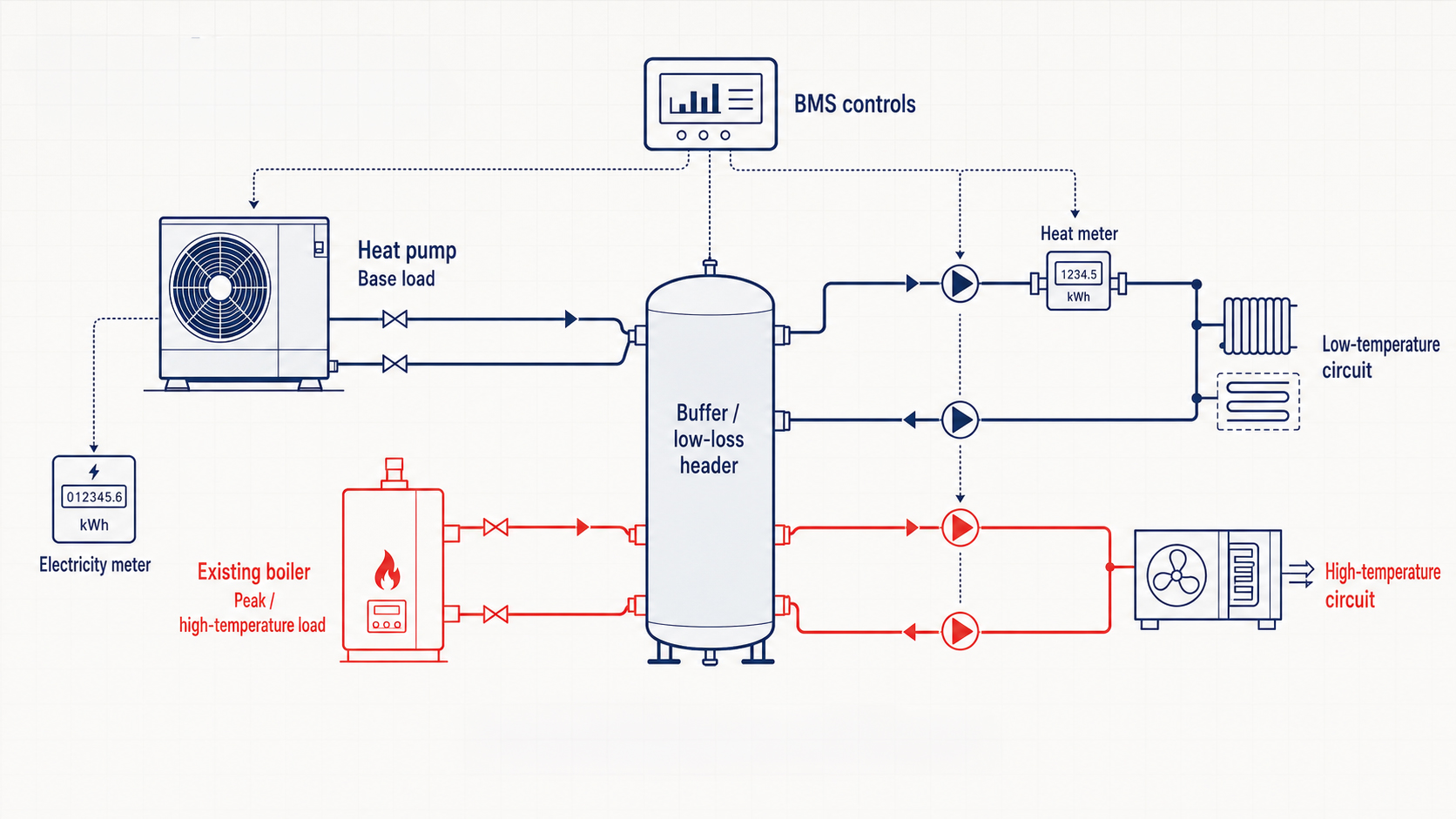
A typical heat pump hybrid system. Actual system designs vary according to building requirements.
03
Is sufficient electrical capacity available?
Replacing fossil-fuel heating with a heat pump transfers a significant part of the building’s energy demand to its electrical system. The feasibility assessment should consider the complete installation, including pumps, immersion heaters, trace heating, crankcase heaters, controls and any electric backup provision.
The highest heating demand may coincide with other significant electrical loads. A school, office, hotel, healthcare property or manufacturing facility will each have a different demand profile.
Our solutions include reviewing recorded demand, the incoming supply, switchgear, distribution equipment and future loads such as EV charging. This identifies whether the existing installation can support the heat pump or requires electrical upgrades and load-management measures.
04
Is there a suitable plant location?
Commercial heat pumps require suitable space, access and environmental conditions. A location should not be selected solely because it is close to the existing plant room. Multiple external units must be arranged carefully. Poor spacing or enclosure can allow cold discharge air to return to the evaporator, reducing available capacity and efficiency when heat is needed most.
The internal installation may require more space than the equipment it replaces. Depending on the design, provision may be needed for assets such as buffer vessels, expansion vessels, heat exchangers, water-treatment equipment and controls
As part of the feasibility assessment, we survey the building for:
- Airflow and cold-air recirculation
- Acoustic impact
- Structural loading
- Maintenance and replacement access
- Condensate and defrost drainage
- Pipework and electrical routes
- Internal space for buffers, pumps and associated plant
- Planning and visual requirements
Resolving these points early helps prevent costly changes after equipment selection.

Well-designed Building Management Systems (BMS) enable operators to analyse and optimise heating system efficiency.
05
How will the system be controlled?
Even correctly sized equipment can perform poorly if the control strategy causes unnecessarily high temperatures, short cycling or conflict between systems.
Frequent starts and stops can reduce efficiency and place additional wear on compressors and associated equipment. The design should calculate the required water volume and minimum run time rather than adding a buffer vessel without a defined hydraulic purpose.
The Building Management System (BMS) should monitor useful data points including flow and return temperatures, electrical consumption, coefficient of performance (COP) and operating hours. The integration of heat meters and appropriately located electricity meters allows the operator to calculate actual system efficiency.
Without this information, higher energy use may remain undetected or be attributed incorrectly to the heat-pump technology rather than a commissioning or control problem.
From feasibility to specification
A defensible heat-pump specification should include:
- Calculated heat demand
- Confirmed system temperatures
- Emitter and pipework assessments
- Electrical-capacity checks
- Plant-location and acoustic reviews
- A defined hydraulic arrangement
- A written control sequence
- Commissioning and performance-monitoring requirements
By considering the complete mechanical and electrical installation, we can develop the most appropriate solution, whether that is a heat pump, hybrid system or an alternative commercial heating upgrade.
Innovation, Expertise, Excellence
Watsons Building Services provides integrated mechanical, electrical and controls expertise for commercial heating projects. We can assess your existing system and develop a practical solution around the building’s performance, infrastructure and operational needs.
Frequently Asked Questions
No. We assess existing radiators and other emitters at the proposed flow and return temperatures. Some may have sufficient capacity, while others may need enlarging, supplementing or replacing to maintain comfort. A room-by-room assessment avoids unnecessary upgrades.