- 01535 652338
- mail@watsonsbs.com


Blog

VRF or Split Systems: A Decision Framework
WBS
General
Choosing between variable refrigerant flow (VRF) and split air conditioning systems is not simply a comparison of specifications. The appropriate solution depends on how the building is zoned, occupied, controlled and maintained, alongside its resilience requirements and whole-life costs.
Facilities managers bring important operational knowledge to this assessment. Understanding how spaces are used, where comfort issues occur and which areas are business-critical helps establish whether a proposed arrangement is right for the building.
What is the difference between VRF and split air conditioning?
A split system typically connects one indoor unit to one outdoor unit. Multi-split systems can connect several indoor units to shared outdoor equipment.
VRF connects a larger number of indoor units through shared refrigerant circuits, varying refrigerant flow to meet demand across individual zones. Some systems provide either heating or cooling at a given time, while heat-recovery VRF can heat some areas while cooling others.
These differences affect zoning, controls and maintenance, but do not determine the best solution on their own.
At a glance: VRF or split systems?
There is no universally better option. This framework can help identify which approaches warrant further assessment, supported by a building survey, load calculations and detailed design.
Consideration | Split systems may suit | VRF may suit |
|---|---|---|
Zones | A small number of independent rooms | Numerous zones with different demands |
Occupancy | Predictable operating hours | Occupancy that varies between building areas |
Controls | Spaces where simple localised control is sufficient | Buildings where central monitoring and BMS integration are valuable |
Installation | Buildings where short pipework routes are practical | Buildings where external plant space is restricted |
Maintenance | Buildings where short pipework routes are practical | Centralised equipment can be maintained effectively |
Whole-life cost | Incremental replacement offers value | Diversity and heat recovery provide measurable benefits |
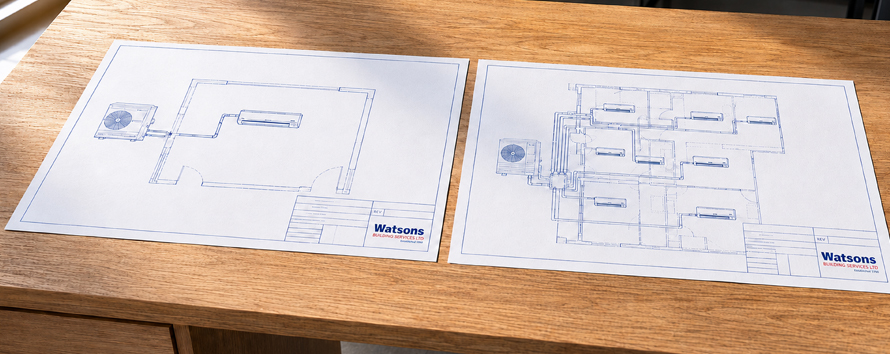
Key considerations
A building may point towards VRF in some areas and split systems in others. The following questions help assess which arrangement best supports its operational requirements.
01
How many zones are required?
The number and diversity of zones can matter more than total floor area. Splits may suit a small number of independent rooms. As the number of zones increases, however, they can create numerous outdoor units, electrical supplies, controllers and maintenance points. VRF may provide a more coordinated arrangement for multiple zones. Whichever approach is proposed, zoning should reflect how spaces are used rather than being shaped around the equipment.
02
How does occupancy change?
Meeting rooms, hybrid offices and training areas can experience substantial changes in demand. VRF may suit buildings where loads vary between connected zones, although this diversity should be calculated rather than assumed. Splits may remain appropriate where occupancy is predictable, or spaces operate independently. The assessment should reflect typical operating hours and occupancy patterns, not only peak design conditions.
03
What level of resilience is needed?
A split-system fault will generally affect the room or zone served by that unit. A fault on a shared VRF circuit may affect several indoor units, although dividing the building across suitable circuits can reduce this exposure. Critical or extended-hours spaces, such as server rooms, may require dedicated equipment. Resilience should therefore be assessed according to the operational consequences of failure.
04
How will the system be controlled?
Local controls may be sufficient for a limited number of independent rooms. Across a larger building, managing numerous controllers and schedules can become difficult. VRF can support central scheduling, monitoring and BMS integration. Whatever the system, the controls strategy should establish:
- Permitted temperature ranges
- Occupancy and operating schedules
- How conflicting demands will be managed
- What facilities teams need to monitor
Controls should form part of the design. A capable system can still perform poorly if its controls are unclear or unnecessarily complicated.
05
Can it be installed and maintained properly?
VRF can reduce the number of outdoor units but requires a more extensive shared refrigerant network. Splits use shorter, independent circuits but may require more external units, electrical supplies and maintenance points. The assessment should consider pipework routes, noise and safe access to units, filters, condensate systems, controllers, valves and branch components. Refrigerant safety requirements must also be addressed. The installation should remain practical to commission, inspect, service and eventually replace.
06
What will it cost over its working life?
The lowest installation price does not necessarily represent the lowest lifecycle cost.
VRF may provide benefits where load diversity, heat recovery and central control are genuinely useful. Splits can offer simpler isolation and phased replacement, although maintaining numerous individual systems may increase cost and complexity.
A whole-life comparison should consider:
- Installation and electrical infrastructure
- Controls and integration
- Expected energy consumption
- Planned maintenance and replacement parts
- Disruption following failures
- Future alterations and eventual replacement
Any projected savings should be based on realistic operating conditions, not headline product figures.
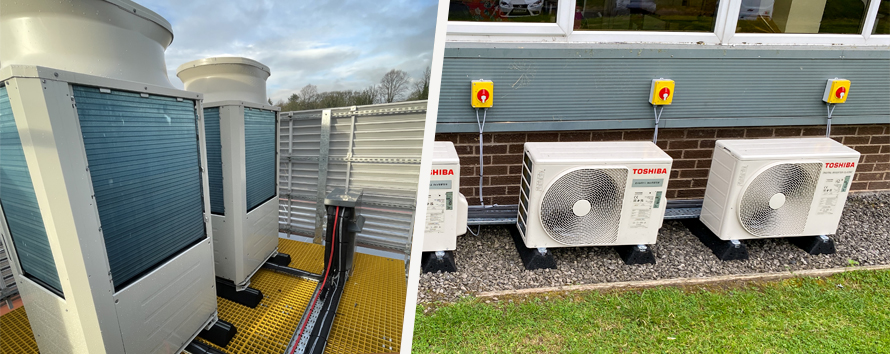
VRF and split systems, as designed and installed by Watsons Building Services
Could the building need both?
The decision does not have to be VRF or splits throughout the entire building. A mixed arrangement might use VRF for general accommodation and dedicated splits for critical, specialist or extended-hours spaces. Existing systems may also be retained where their condition, performance and remaining service life justify it.
The objective is to give each part of the building the appropriate comfort, control and resilience without introducing unnecessary complexity. Assessing zoning, occupancy, failure risk, controls, installation constraints and whole-life costs together provides a stronger basis for deciding whether VRF, splits or a mixed arrangement is the right fit.
Innovation, Expertise, Excellence: Commercial air conditioning designed around your building
Watsons Building Services assesses the building, its loads and its operational priorities before recommending an air-conditioning solution. We can support the process from survey and system design through to installation, commissioning and ongoing maintenance.
Frequently Asked Questions
Potential indicators include persistent hot or cold areas, frequent occupant complaints, simultaneous heating and cooling, excessive cycling, difficult controls and systems operating in empty spaces. These symptoms do not confirm a design fault, but they justify further investigation into loads, zoning, controls and system condition