- 01535 652338
- mail@watsonsbs.com


Blog
A Shared Decision Framework For Commercial Heating Systems
WBS
General
Deciding whether to repair, upgrade or replace commercial heating requires operational knowledge and technical assessment. Building and facilities managers understand how the building operates, where problems occur and what disruption is acceptable. Watsons Building Services brings the engineering assessment needed to establish the causes, evaluate options and recommend an appropriate intervention.
This guide explains how that shared process moves from identifying a problem to delivering and verifying an improvement.
01
Define the problem and the required outcome
Poor comfort, rising consumption and recurring faults can have different causes. Establishing the symptoms helps focus the investigation.
Facilities managers contribute:
- Temperature complaints and affected rooms or zones.
- Fault history, repair expenditure and downtime.
- Occupancy hours and changes in building use.
- Available energy data and maintenance records.
- Details of temporary heaters, overrides and other workarounds.
Watsons assesses:
Plant operation, controls, heat distribution and available performance data to distinguish equipment faults from capacity, scheduling or system issues. Together, the team agrees measurable objectives, such as more consistent temperatures, reduced consumption or fewer service interruptions.
Shared outcome: A defined problem and an agreed basis for assessing improvement.
02
Establish whether to optimise, repair or replace
Watsons assesses the heat source, pumps, pipework, valves, emitters and controls as an integrated system. Facilities managers help establish the operational consequences of retaining or replacing equipment.
Intervention | When it may be appropriate | What the assessment establishes |
|---|---|---|
Optimisation | Serviceable plant with poor control or uneven distribution | Opportunities through scheduling, controls adjustment and hydraulic balancing |
Repair | An isolated fault within an otherwise serviceable system | Root cause, parts availability and expected reliability |
Partial upgrade | A component or zone restricts performance | Compatibility with retained equipment and controls |
Plant replacement | Recurring failures, deteriorating condition or changed requirements | Required duty and suitability of existing infrastructure |
System redesign | Major refurbishment, expansion or heat decarbonisation | Coordinated thermal, hydraulic, electrical and controls requirements |
Plant age is considered alongside condition, maintenance history and manufacturer support. For example, underheating in one wing may result from inadequate flow or valve faults. Replacing central plant would leave those causes unresolved.
Shared outcome: An intervention proportionate to the fault, asset condition and operational risk.
03
Confirm the building’s heating requirements
Facilities managers provide current operating requirements and confirmed plans for the building. Watsons uses this information to establish the technical design basis.
The assessment considers:
- Building and zone heat losses at winter design conditions.
- Ventilation heating loads.
- Occupancy schedules and warm-up requirements.
- Domestic hot water demand and recovery duty.
- Confirmed future loads.
- Capacity required during maintenance or plant failure.
Replacement equipment should not be sized solely from the existing boiler rating. Peak duty, annual demand and part-load operation all influence selection. Where fabric improvements are planned, their effect on heat demand and operating temperatures should be incorporated.
Shared outcome: An agreed design duty that reflects how the building operates and its foreseeable requirements.
04
Compare technically suitable options
Watsons assesses suitable heating technologies against building demand, existing infrastructure and operating requirements. Facilities managers help weigh the options against budgets, estate plans, maintenance arrangements and operational priorities. Each option is assessed for capacity, efficiency, distribution, controls, resilience and installation requirements.
Boiler-based systems
Gas, oil or electric boiler systems may serve existing radiators, fan convectors and air-handling coils through a hot water distribution network. The assessment considers plant sizing, modulation, sequencing, operating temperatures, fuel or electrical supply, and distribution condition. Flues, combustion ventilation and condensate drainage are reviewed where applicable.
Heat pump systems
Air-source or ground-source heat pumps require assessment of source availability, operating temperatures, emitter output and seasonal performance. Watsons checks hydraulic requirements, electrical capacity, plant space, noise and hot water provision, identifying which existing components can be retained or require modification.
Warm-air heating
Direct-fired or indirect-fired warm-air systems may suit warehouses, workshops and other large spaces. Selection considers heat distribution, mounting positions, air movement, temperature stratification and losses through frequently opened doors. Fuel supply, flues and ventilation requirements are assessed according to the equipment type.
Radiant heating
Radiant systems may suit high-ceilinged buildings or defined work areas where heating the entire air volume is unnecessary. The assessment considers occupancy patterns, mounting height, coverage, obstructions and clearances from stored materials. Gas-fired and electric options have different supply, installation and operating-cost implications.
Electric resistance heating
Panel heaters, convectors and other local electric heaters may suit small, intermittently occupied areas or locations where extending central distribution is impractical. Watsons assesses electrical capacity, controls and expected operating hours. Low installation complexity must be weighed against forecast running costs.
Hybrid and mixed systems
Different technologies may serve different zones or work together to meet base and peak loads. Watsons defines heat-source priority, changeover conditions, controls integration and backup capacity. Facilities managers help establish whether the arrangement remains practical to operate and maintain.
Shared outcome: A shortlist of suitable systems, with clear comparisons of technical requirements, whole-life costs and operational implications.
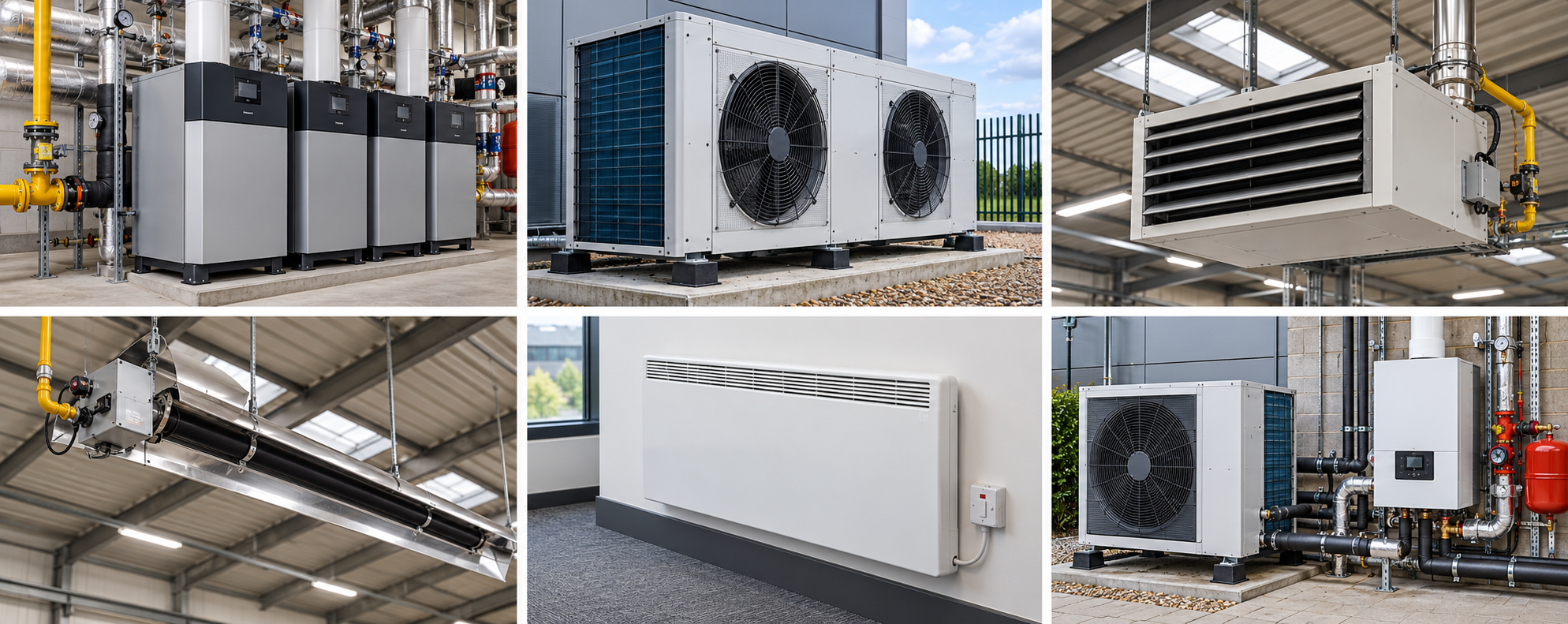
Commercial heating options include boilers, heat pumps, warm-air, radiant, electric and hybrid systems. Suitability depends on building demand, infrastructure and operating requirements.
05
Develop the business case
Watsons provides the technical scope and performance assumptions. Facilities managers contribute tariffs, budget parameters, disruption costs and the organisation’s investment criteria.
Options should be compared over a common assessment period, including:
- Design, equipment and installation.
- Electrical, hydraulic and building enabling works.
- Controls integration, commissioning and metering.
- Forecast energy consumption and maintenance.
- Temporary services and operational disruption.
- Carbon performance and future conversion requirements.
Running-cost estimates should use site-specific tariffs and seasonal system performance, including auxiliary consumption and supplementary heating. Sensitivity checks show how changes in tariffs, occupancy or performance affect the result. Funding can be assessed separately until eligibility and availability are confirmed.
Shared outcome: A recommendation supported by transparent costs, assumptions and operational benefits.
06
Plan delivery and verify performance
Facilities managers define access arrangements, critical services and acceptable shutdown periods. Watsons develops the installation sequence, temporary-service requirements and commissioning plan around those constraints. For phased works, the plan establishes how retained and new equipment will interact throughout the programme.
Handover should include:
- Commissioning and hydraulic balancing records.
- Functional testing of sequencing, interlocks, alarms and specified backup operation.
- Controls descriptions, setpoints and schedules.
- Updated drawings and maintenance information.
- Operator training and access to performance data.
A review during the first heating season allows actual operation to be checked against the agreed objectives. Facilities managers report comfort and reliability issues; Watsons reviews system performance and identifies any necessary adjustments.
Shared outcome: A commissioned system, informed operators and evidence that the improvement meets the building’s needs.
Innovation, Expertise, Excellence: Preparing for an assessment with Watsons
Facilities managers can help make the initial assessment more productive by gathering:
- A summary of the problem and affected areas
- Occupancy hours and critical heating requirements
- Service records, asset schedules and available drawings
- Energy data and controls trends
- Planned refurbishment or expansion
- Budget, carbon and shutdown constraints
Frequently Asked Questions
Potentially. Watsons assesses heat demand, operating temperatures, emitter output, electrical capacity and site constraints. Facilities managers provide operating requirements and estate plans. Together, these establish whether full replacement, hybrid operation or preparatory upgrades are appropriate. Read our guide on specifying commercial heat pumps.