- 01535 652338
- mail@watsonsbs.com


Blog

Preparing Commercial Building Services for a Christmas Shutdown
WBS
Guides
A Christmas shutdown changes the operating conditions of a building’s mechanical and electrical systems. Reduced demand, extended heating setbacks and maintenance isolations can affect protective controls, shared services and recovery performance.
This guide examines five key mechanical and electrical (M&E) considerations involved in preparing a commercial building for a planned Christmas shutdown and restart.
01
Heating setbacks and frost protection
Setback temperatures and recovery schedules should reflect building heat loss, thermal mass, available heating capacity and circuit zoning. Where plant capacity is constrained, a deep setback may extend recovery beyond the available preheat period.
Frost protection requires a separate review of the complete control sequence. Where protection relies on circulation, a low-temperature signal must enable the necessary pumps, open the relevant valves and make heat available. Local frost thermostats and Building Management System (BMS) commands need to operate together, including outside normal heating hours.
Particular attention should be given to exposed pipework, air handling unit (AHU) coils, external plant and unheated spaces. A satisfactory reading at the controlling sensor may not represent conditions at the most vulnerable component. For glycol-protected circuits, confirm that fluid concentration and condition remain suitable for the required protection. Trace heating and insulation should also be checked where they form part of the protection strategy.
02
Ventilation and critical cooling
Reduced ventilation rates can affect supply and extract balance, humidity control and associated heating or cooling sequences. AHU shutdown settings should account for coil frost protection, damper positions and pump or valve interlocks. Where airflow is reduced, check that temperature-control sequences remain stable and do not create unnecessary simultaneous heating and cooling.
Comfort cooling and equipment cooling need separate schedules. Server rooms, communications spaces and process areas may retain substantial cooling loads despite reduced occupancy. Their cooling provision, alarms and supporting electrical supplies must remain available. Changes to normal ventilation operation must also preserve any interfaces with smoke control and other life-safety systems.
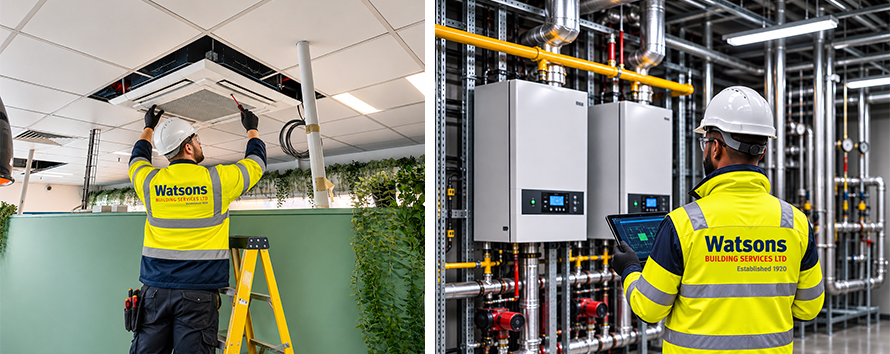
Watsons Building Services helps facilities managers plan shutdowns and maintenance, protect essential systems, reduce energy use and ensure a smooth return to normal operation.
03
BMS controls and electrical dependencies
Shutdown schedules should be checked at controller level, particularly where local time clocks, standalone controls or manual overrides can supersede the central BMS. The review should cover:
- Unoccupied and frost-protection sequences, including plant enable conditions.
- Shared pumps, control supplies and interlocks affected by proposed isolations.
- Critical alarms, communications and remote monitoring.
- Overrides that could prevent automatic shutdown or restart.
Electrical isolation boundaries should be checked against actual system dependencies. Removing power from apparently inactive plant can also disable controllers, actuators, trace heating or communications required elsewhere. A functional test of the proposed shutdown mode can reveal conflicts that are not apparent from the schedule alone.
04
Water systems under reduced demand
Extended periods of low water use can increase stagnation and water age, potentially affecting water quality and Legionella risk. Shutdown arrangements should follow the building's water safety risk assessment, written scheme of control and relevant HSE guidance, including HSG274 Part 2. Key considerations should include little-used branches, storage turnover and hot-water generation and circulation.
Reducing hot-water operating hours can affect temperatures throughout the distribution system. Any proposed isolation or draining should therefore be assessed against the system configuration and the requirements for returning it to service.
Where maintenance changes the system’s condition, reinstatement may require more than restoring supplies. Flushing, temperature verification, disinfection or other measures should follow the assessed risk and scope of work.
05
Maintenance isolation and staged recovery
Shutdown maintenance can temporarily remove the systems providing frost protection, circulation or critical cooling. Isolation plans should identify these dependencies and allow time for testing and fault resolution before reopening. Heating recovery should reflect the depth and duration of the setback, forecast conditions and available capacity. Optimum-start controls may support recovery where configured appropriately; staged plant operation may help manage coincident demand.
Reinstatement checks should confirm automatic control, pump and valve operation, ventilation performance and critical cooling availability. Temporary overrides and isolations should be reconciled against the completed work, alongside any required water-system checks.
Innovation, Expertise, Excellence: Preparing your building for the Christmas shutdown
Watsons Building Services supports facilities managers with planned maintenance, control-sequence reviews and shutdown works across heating, ventilation, electrical and water systems. Contact our team to discuss the technical requirements of your Christmas shutdown.
Frequently Asked Questions
There is no universal setback temperature. The appropriate setting depends on building construction, heating capacity, frost exposure, equipment requirements and recovery time. Frost-sensitive plant and pipework may require additional protection independently of room temperature settings.