- 01535 652338
- mail@watsonsbs.com


Blog
A Guide to Commercial Chiller Maintenance and Replacement
WBS
General
Commercial chillers support comfort cooling, process cooling and temperature-critical operations, including critical hospital environments such as operating theatres and laboratories. When performance deteriorates, the consequences can extend beyond higher energy use and unstable temperatures to clinical disruption and increased operational risk.
Managing these systems effectively requires more than responding to individual alarms. Facilities teams need a clear understanding of the chiller’s condition, its interaction with the wider building services and the point at which continued repair becomes less economical or reliable than planned replacement.
This guide explains the role of commercial chiller maintenance and the factors that should inform a repair-or-replacement decision.
Why is planned chiller maintenance important?
Planned maintenance helps maintain reliability while giving building operators the information needed to anticipate repairs and future capital expenditure. It can also reduce the risk of a fault developing into a more costly compressor, heat-exchanger or electrical failure.
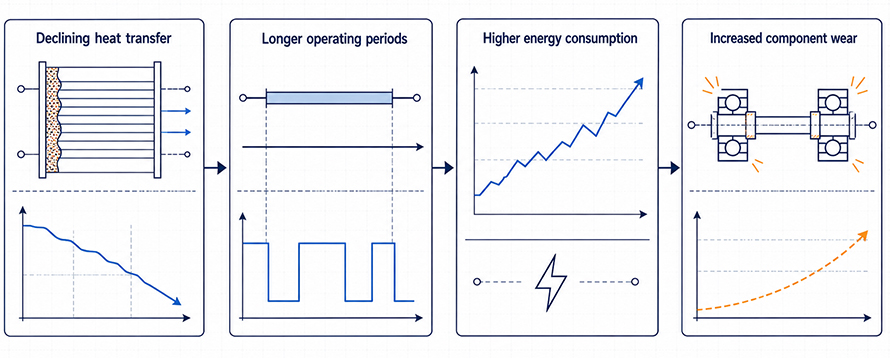
Fouled heat-transfer surfaces, restricted airflow, incorrect water flow and unsuitable control settings can all make a chiller work harder to meet demand. The system may continue cooling, but use more electricity, operate for longer and place additional wear on compressors, fans and pumps.
Consistent service records are particularly valuable. Tracking temperatures, pressures, power demand, alarms and operating behaviour over time can reveal gradual deterioration that may not be obvious during a single inspection.
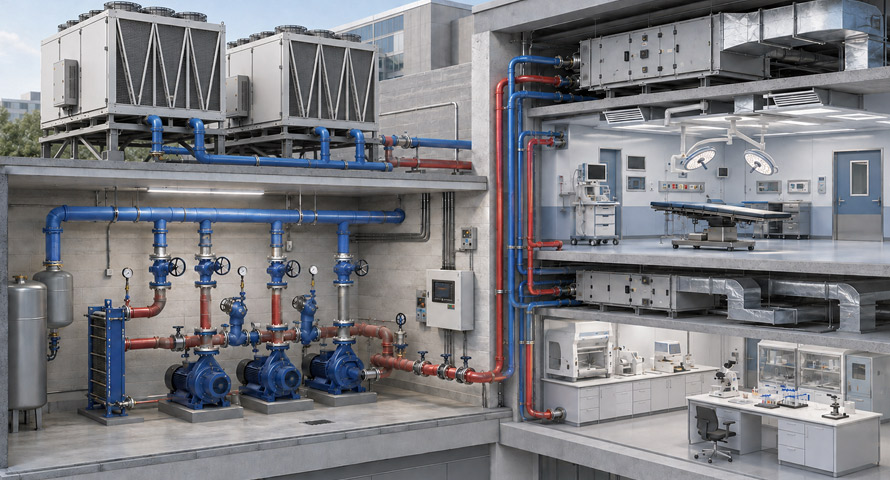
A hospital chilled-water system would include multiple pumps and segregated circuits so a single fault does not remove cooling from critical areas.
What should be checked during a commercial chiller service?
A commercial chiller service should combine a physical inspection with operating measurements, electrical checks and control testing.
The engineer should look for:
☑️ Corrosion
☑️ Damaged insulation
☑️ Contamination
☑️ Loose connections
☑️ Signs of refrigerant or oil leakage
Operating temperatures and pressures should be assessed against current system demand, design information, previous readings and the manufacturer’s expected operating range. Condenser coils and heat exchangers must remain sufficiently clean to transfer heat effectively. Restricted air-cooled condenser coils can increase condensing pressure, while scale or fouling within a water-cooled system can produce a similar loss of efficiency. Sensors, alarms, safety devices and control sequences also require attention. Incorrect readings or poor control settings can cause excessive cycling, unstable water temperatures or inefficient staging between multiple chillers.
Service frequency should reflect the manufacturer’s recommendations, operating hours, environment and consequences of failure. A suitable programme will normally combine routine checks, seasonal preparation and more detailed periodic servicing.
How declining heat transfer affects chiller performance
Can maintenance restore chiller efficiency?
Maintenance can recover performance where the loss is caused by fouling, restricted airflow, poor water flow, sensor errors or inefficient control settings. Cleaning heat-transfer surfaces and correcting system conditions may reduce unnecessary compressor loading and improve temperature stability.
Maintenance cannot reverse every form of deterioration. Worn compressors, damaged heat exchangers, obsolete controls and persistent refrigerant leaks may require major investment. An older chiller may also remain less efficient than current equipment even when operating correctly. The value of further maintenance should therefore be considered alongside reliability, remaining service life and operational risk.
When should a commercial chiller be replaced?
Replacement should be considered when the existing chiller can no longer provide the required capacity, efficiency, reliability or maintainability at an acceptable cost. Age alone should not determine the decision. Operating hours, maintenance history, site conditions and loading can leave chillers of a similar age in very different condition. A condition-led assessment provides a stronger basis for investment.
Replacement becomes more compelling when major faults are recurring, components are becoming obsolete or spare parts are difficult to obtain. Refrigerant availability, environmental requirements and the operational consequences of failure may also affect the case for retaining older equipment. Where the loss of cooling could interrupt production, affect critical areas or force parts of a building to close, the risk of continued operation must be included in the financial assessment.
Innovation, Expertise, Excellence: Commercial Chiller Maintenance or Replacement
Whether you are dealing with recurring faults, rising energy costs or equipment approaching the end of its practical service life, Watsons Building Services can help establish the right course of action. Our engineers assess the chiller alongside the connected pumps, pipework, controls and operational requirements. From planned maintenance and condition assessments to remedial works and complete chiller replacement, we provide a coordinated solution focused on reliability, efficiency and long-term value.
Frequently Asked Questions
There is no single service life that applies to every commercial chiller. Equipment type, operating hours, loading, installation quality, environment and maintenance history all influence longevity. Condition and performance should be assessed alongside age when deciding whether a chiller can remain in service.