- 01535 652338
- mail@watsonsbs.com


Blog
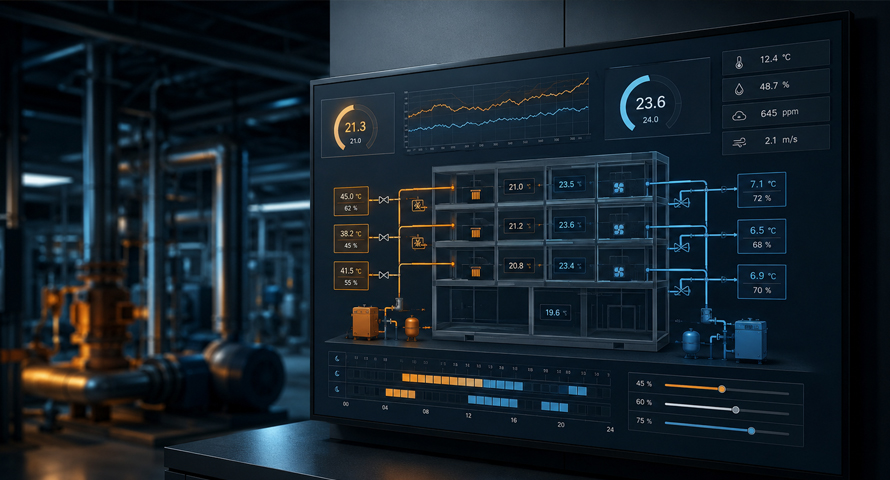
Preventing BMS Problems During Seasonal Changeover
WBS
General
When a commercial building moves from heating to cooling (or back again), familiar comfort complaints often return. Rooms become too warm or cold, systems operate outside expected hours, and heating and cooling may run simultaneously.
These problems are frequently attributed to the mechanical plant. However, boilers, chillers, pumps and air-handling units may all be operational. The underlying problem can instead lie within the building management system (BMS), its settings, sensors, schedules, overrides or control sequences.
A seasonal changeover places new demands on the BMS. Control strategies that remained largely dormant for several months must activate correctly and coordinate equipment across multiple systems and zones. Any weakness in that process quickly becomes visible.
What does a BMS do during seasonal changeover?
A BMS monitors building conditions and controls connected HVAC equipment according to programmed operating sequences. During seasonal changeover, it may need to enable or disable the heating and cooling plant, adjust temperature setpoints, change operating schedules and control pumps, valves and air-handling equipment.
The transition is not always a simple switch between two modes. During spring and autumn, external temperatures can vary significantly throughout the day. A building may require heating in the morning and cooling by the afternoon. The BMS must interpret sensor data, apply the correct control logic and prevent different systems from working against each other. Problems arise when that logic no longer matches the building, its equipment or how its spaces are used.
Conflicting control strategies
Simultaneous heating and cooling is a common sign of poor BMS coordination. One system may be trying to lower the temperature while another adds heat to the same space. This can happen when setpoints overlap, deadbands are too narrow or separate items of equipment follow conflicting instructions. Local controls may also operate independently of the central BMS, creating additional layers of control that are difficult to identify.
Although occupants may only notice an inconsistent room temperature, the wider effects can include extended plant operation, unnecessary energy use and accelerated component wear. Reviewing the full sequence of operation is essential. Each item of equipment may appear to be responding correctly when viewed alone, while the combined system performs inefficiently.
Incorrect schedules and setpoints
Operating hours and occupancy patterns change, but BMS schedules do not always change with them. Equipment can begin too early, stop too late or operate when areas of the building are unoccupied.
Seasonal setpoints may also be inappropriate. If heating and cooling thresholds are positioned too closely together, the BMS can repeatedly switch between modes or call for both at once. This creates unstable conditions and wastes energy without delivering better comfort. Schedules, setpoints and control bands should reflect current occupancy, building use and plant capability. Copying settings from a previous season without reviewing performance can allow known inefficiencies to continue.
When heating & cooling overlap
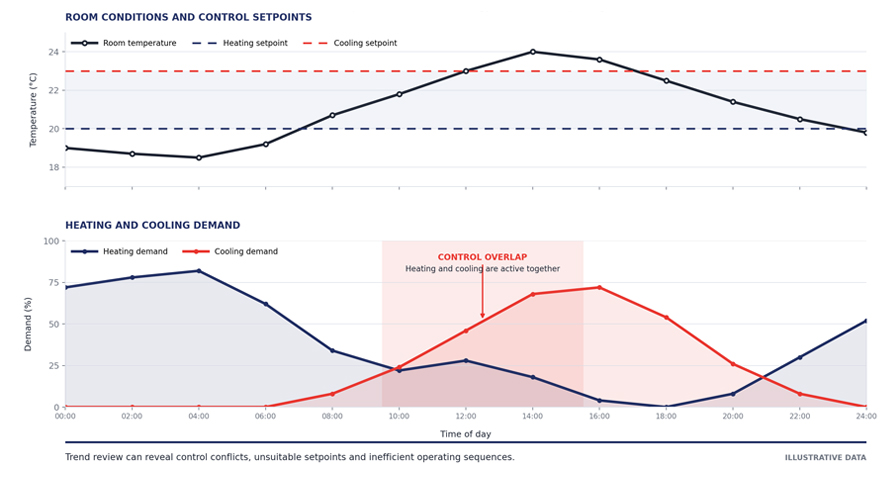
Illustrative trend data, demonstrating how conflicting control responses can increase energy use without improving comfort.
Overrides that outlast the original problem
BMS overrides are often applied during maintenance, fault investigation or exceptional operating conditions. They can keep a building functioning while a permanent solution is arranged, but temporary changes are not always removed.
A forced pump command may keep circulation running continuously. An overridden valve can remain open regardless of demand, while a manually enabled air-handling unit may operate outside the building’s normal schedule. Over time, these changes can accumulate. Engineers investigating a new complaint may then be dealing with several historic adjustments, each affecting how the current control sequence performs. Active overrides should be recorded, regularly reviewed and removed when no longer required. An unexplained override is often evidence that an earlier fault was managed rather than fully resolved.
Sensor errors affect every control decision
A BMS can only make reliable decisions when it receives accurate data. Faulty, poorly positioned or incorrectly calibrated sensors can cause the system to respond to conditions that do not exist. An inaccurate outside-air sensor may initiate the wrong seasonal mode. A room sensor exposed to direct sunlight can create an unnecessary cooling demand, while one positioned close to heat-producing equipment may suppress heating in an otherwise cold space. The reading shown on the BMS should be compared with an independent measurement.
Engineers should also consider whether the sensor’s location accurately represents the area it controls. A functioning sensor in the wrong position can still produce poor building performance.
Incomplete controls commissioning
BMS issues commonly arise after HVAC replacement, refurbishment or changes to room use. New plant may have been connected and proven operational without fully testing its interaction with the existing controls. Effective commissioning should verify more than whether equipment starts and stops. It should confirm that sensor values are credible, commands reach the correct assets, alarms operate as intended and heating and cooling sequences respond correctly under realistic conditions.
The handover should also leave the facilities team with an accurate description of the control strategy. Without this, future adjustments can be made without understanding their effect elsewhere in the system.
Using BMS data to identify recurring problems
A BMS provides valuable information for investigating seasonal faults, but live status screens only show what is happening at that moment. Trend data is often more useful because it reveals how temperatures, setpoints, valve commands and plant operation change over time.
By comparing these values, engineers can identify short cycling, persistent overrides, simultaneous heating and cooling, incorrect start times and control responses that do not match actual demand.
Innovation, Expertise, Excellence: Delivering expert BMS solutions that respond reliably to changing demand
Watsons Building Services delivers BMS solutions that bring HVAC plant, controls and building operation together. From controls upgrades and system integration to optimisation and fault diagnosis, our engineers use BMS data to identify conflicts, correct inefficient sequences and improve visibility across connected building services.
Frequently Asked Questions
Often, yes. Many existing systems can deliver better performance through revised schedules and setpoints, sensor recalibration, removal of unnecessary overrides and improvements to control sequences. Watsons Building Services can assess the condition, compatibility and capabilities of your current system before recommending optimisation, upgrades or replacement.
Learn more about our BMS solutions, including controls integration, system upgrades, remote monitoring and ongoing optimisation.